Trail left from meteorite.
In the past week, on 15 February 2013, there was a meteorite that hit Russia. It was the largest meteor to hit since the Tunguska meteorite in 1908. It has been long thought of that this could happen again. And in 2013, it did happen again. To truly have an understanding of the impact of the Chelyabinsk meteorite, it is important to look at the Tunguska event.
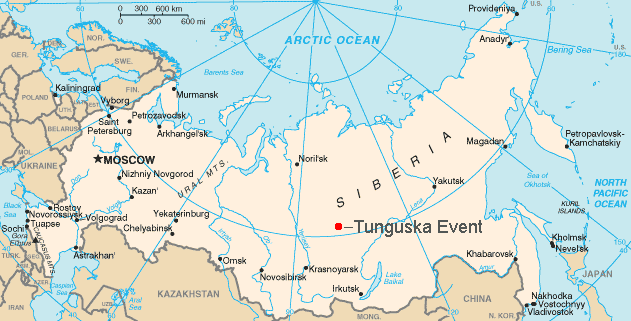
First question is this. Where is Tunguska? Well, it is actually the Podkamennaya Tunguska river. It is a tributary that leads into the Yenisei river, located in the federal subject of the Krasnoyarsk Krai, in central Siberia. The Yenisei river starts in Mongolia, is fed by the Angara, Kan, Podkamennaya Tunguska, and Nizhnyaya Tunguska rivers, and flows into the Arctic Ocean. The largest city along the Yenisei river is Krasnoyarsk.
The first peoples to inhabit this region were the Evenk people. Later on, Russians came from the western part of Russia.
Location of Tunguska in relation to Siberia(top), and the Yenisei river region(bottom)
Now, the event can be discussed. It is widely believed that a meteorite his this spot, causing an explosion on 30 June 1908. It was the largest impact event to ever happen on the earth at that time. It has been thought of that the meteorite might have exploded in the air rather than hitting the ground. Either way, the impact was immense. This blast was 1,000 times more powerful than the atomic bombed that was dropped on Hiroshima,Japan.
The effect of this blast was felt throughout Eurasia. It caused shock waves that registered 5.0 on the Richter scale. The blast also caused changes in the atmospheric pressure that could be found as far away as Great Britain. The forest areas where the blast took place were blown down. One person was killed.
A forest after the Tunguska event. This picture was taken by Leonid Kulik in 1930, 22 years after the explosion.
Now for the Chelyabinsk event. To get an idea of this event, it is important to know where Chelyabinsk is. This is a major city in Siberia, near the Ural Mountains. It is a major center for metallurgy and military machinery.
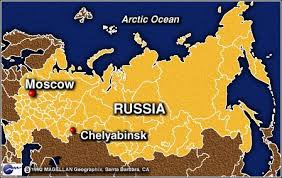
The Chelyabinsk meteorite event is known as the largest impact event since the Tunguska event. It, however, was not as powerful as the Tunguska event. This being said, the impact cannot be measured so much in how explosive it was, but who it affected. In Tunguska, there was one death, and atmospheric changes occurred, as well as seismic changes. In the Chelyabinsk event, this happened in a populated area, where people were living. At least 1,200 people were injured from the blast. There wasn't an actually meteorite that hit the city of Chelyabinsk. However, the effect of it caused damage in Chelyabinsk. Thousands of buildings were damaged and at least 1,200 people were injured. Schools were closed because of the damage. To understand why schools were closed, it is important to assess the climate of Siberia. This is Siberia in February. The average daytime temperature is 17.8 degrees Fahrenheit(-7.9 degrees Centigrade) and at night, the average is -2 degrees Fahrenheit(-18.9 degrees Centigrade). With broken windows, this would be harmful for children in the schools, as temperatures would become almost as cold indoors as outdoors. A zinc factory was damaged. Considering that metallurgy is an important part of Chelyabinsk's economy, this could have an effect on the economy. The damage might cost people for a reason. More time would be needed to rebuild the factory, which takes away time from producing zinc.
One thing to consider with the Chelyabinsk meteor event vis-a-vis Tunguska is its over all effect. Both are events in their own way, but different ways. In the Tunguska event, this caused an affect on atmospheric pressure and was even detected on the Richter scale. In the Chelyabinsk event, this effect a major city. The events of Chelyabinsk can tell alot about how an urban area can be effected by events such as a meteorite vs rural areas being hit by a meteorite.
http://online.wsj.com/article/SB10001424127887324162304578305163574597722.html?mod=WSJ_hpp_LEFTTopStories
http://russian.rt.com/Russia/4400
http://science.nasa.gov/science-news/science-at-nasa/2008/30jun_tunguska/