The goal of this blog is to expound upon the subject of geography, on a level that shows a more detailed side of this subject, to show the broadness of geography. Education: B.A. in Geography, Kennesaw State University, July 2012.
Showing posts with label Russia. Show all posts
Tuesday, February 4, 2014
2014 Winter Olympics. Parallels between Sochi and Vancouver.
Sochi, Russia
Vancouver, Canada
The 2014 Winter Olympics and set to begin on Thursday, 6 February. As is known, they will be held in the Russian city of Sochi.
One thing to consider is the fact that these will be the first Winter Olympics to be held in a subtropical climate, at least the indoor events. Some people look at this is very unusual. Although Russia is known for very cold winters, Sochi has a climate similar to southern Japan or the southeastern USA. The average daytime temperature in January is 50 F(10 C) and at night it is 35 F (2 C).
Well, this is to be considered. Vancouver, Canada held the 2010 Winter Olympics. Although Vancouver does not have a subtropical climate, it does have very mild winters in comparison to the rest of Canada. The average January daytime temperature in Vancouver is 45 degrees F(7 degrees C), The average night time temperature is 33 F (1 C). Quite mild for a city at a latitude of 49 N. Canada is known for very cold winters, so Vancouver stands out.
Here are the parallels:
-Vancouver has relatively mild winters. Sochi also has mild winters. Both cities are among the warmest cities in their respective nations. Both nations are known for cold, snowy winters.
-Vancouver and Sochi are located near high mountains. Vancouver held snow-related events in the mountains(especially in Whistler), Sochi will hold snow-related events in the mountains, at Krasnaya Polyana.
-Both cities are coastal cities
Rosa Khutor Alpine Resort, Krasnaya Polyana, Russia
Whistler, Canada
If Vancouver could do it, then Sochi could pull this off too. One way to look at this is from a perspective of geography. While indoor events will be held in Sochi proper, the skiing, luge, and bobsleighing events will be held in Krasnaya Polyana, a town in the mountains, where it will be colder and there would likely be more snow.
Wednesday, January 1, 2014
When Geography and Astronomy Come Together.
A commune (French equivalent of an township) of around 29,000 residents along the coast of French Guiana. Basically, like a small town. There are many who do not even know what French Guiana is, much less, where this small town being spoken of is. However, it has a very strategic importance.
Kourou is the commune being spoken of. It is located along the northern coast of the French overseas department of French Guiana. What is the importance? Well, if one is into astronomy, listen closely.
Map of French Guiana showing there Kourou is in relation to French Guiana's capital, Cayenne.
Map from BBC.
Kourou is where the Guiana Space Center is located. It is a major place for launching French and other European rockets. Why was Kourou chosen?
1) Kourou is located relatively close to the equator
2) The sea provides a large amount of space that is uninhabited.
In order to have a decent place to launch rockets, lots of uninhabited space is necessary, so that the refuse from rocket launches does not land in inhabited areas. In order to do that, rockets much be launched towards the east.
And being relatively close to the equator means that the spin of the earth will give some extra velocity for rockets being launched in the eastern direction.
Diagram explaining launching a Russian rocket from Kourou works. RIA-NOVOSTI
There is it. Geography has proven to be very important for astronomy.
Monday, December 23, 2013
A diamond in the cold.
Yakutsk is located in the northern reaches of Siberia, in what is known as Yakutia. It has the distinction of having the coldest winters for a big city. With winter temperatures averaging −38.6 C(−37.5 F) in January, Yakutsk has the coldest winter temperatures for a city of 100,000 or more residents. Temperatures have been recorded as low as -63 C(-83 F).
However, this very frigid corner of the earth also has an economic importance. Yakutia is a major diamond mining region. Yakutsk is the second largest producer and exporter of diamonds in the world. Although the mines in Yakutia are located west of Yakutsk, 1/5 of the world's diamond production is in Yakutsk. It is this contribution that makes Yakutsk, and Yakutia, a place of economic important. A place many people have not heard of, but has its own distinction as a very cold city, and a major diamond production center.
Thursday, July 11, 2013
Murmansk, the Great Arctic Port
Try to imagine a port city above the Arctic Circle. For some people, such is possible. For others, there is an err of distrust towards such an idea. Well, this is a possibility. In fact, this is the case.
Now try to imagine an Arctic port for which the waters off of the coast remain ice-free all year long, even on the coldest of winter nights. Some people will find this even more impossible. One often cannot imagine the Arctic without imagining the water freezing over.
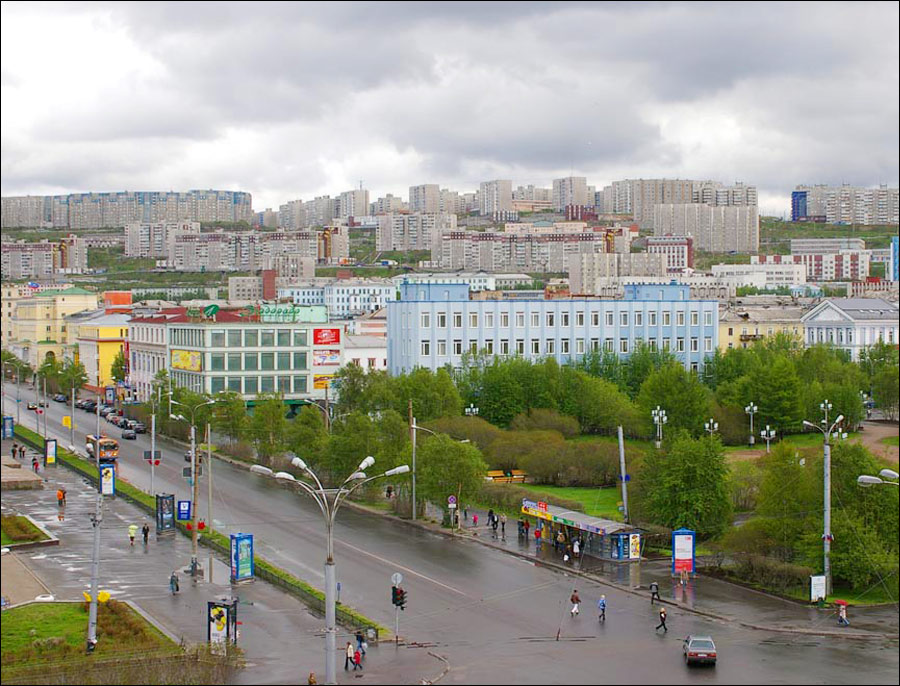
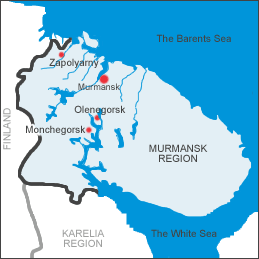
Actually, this is already happening. And that city of Murmansk, Russia. Murmansk is a the largest port city north of the Arctic Circle, as well as being the largest city north of the Arctic Circle. It's location is in the Murmansk Oblast, 12 km from the Barents Sea, inside of a fjord.
And despite being so far north, it remains an ice free port. Murmansk is also the last city to be founded before the collapse of the Russian Empire. It was founded in 1916. It was World War One. Russia needed an ice-free location to have supplies shipped. A railroad was built up to the Murman Peninsula because it was an ice-free location. It's original name was Romanov on the Murman.
How is it that Murmansk, which is so far north, can remain ice free? Well, it has alot to do with ocean currents. It starts with the Gulf Stream. This warm ocean current flows north all the way to Norway and reaches Murmansk. This warm current keeps the waters at Murmansk ice free in the winter. The current works like a conveyor belt, carrying relatively warm water to an otherwise cold location.
Map explaining how Murmansk is ice free.
Murmansk is important because of its location along ice free waters. It is home to a large icebreaker fleet. There is a Russian Navy base in its satellite city, Severomorsk, and 41% of marine transportation comes from this region. This has made Murmansk an important Russian port.
http://englishrussia.com/2011/02/15/severe-arctic-murmansk/
Tuesday, July 2, 2013
The Trans-Siberian railroad;A massive geographic feat.
From the European plain of Russia to the Pacific coast, crossing many time zones, going across 17 rivers, traveling through 2 continents, and many different land forms. That is only a small part of what the Trans-Siberian Railroad is.
The line starts in Moscow, and ends at Vladivostok, in Russia's far east. There is the Trans-Mongolian Railway and the Trans-Manchurian Line. You start from Moscow, but rather than go all the way to Vladivostok, you stop at Ulan Ude and follow the railroad to Beijing via Mongolia. This is the Trans-Mongolian Railway. To travel the Trans-Manchurian Railway, one stops at Chita, and takes that railroad spur to Beijing via the Jilin province of China(formerly known as Manchuria).
In many ways, the Trans-Siberian Railroad is a major geographic feat. The distance of this railroad is quite telling. It is the world's longest railway line.There is literally no other railway line to cross TWO(2) continents. It is one reason it is such a geographic feat. However, this is not the biggest reason why.
In order to get the whole idea of this railroad, one has to know the work that it took to get this railroad built.
Millions of people moved to Siberia from the western portion of Russia. between the 19th and early 20th century. Many were settlers. Many were also prisoners exiled there. For a long time, Siberia had issues with transportation. Before the building of the railroad, rivers served as the main transportation source, when the rivers were not frozen. When the rivers froze over, the rivers were used for transporting goods via carriage or any other form of transportation not involving water. The Great Siberian Route was a major road of transportation.
Previous railway projects for Siberia had been proposed before, but were basically ignored. It was thought to be impossible to build a railway across all of Russia, all the way to the far eastern reaches of Siberia. However, in 1890, the building of the Trans-Siberian Railroad would commence in 1891.It was constructed between 1891 and 1916. Like the American railroad, the Trans-Siberian started building at two different ends. One part started in western Russia, and the other part started in the far eastern part of Russia, around Vladivostok.
Building across long distances was going to be hard enough. However, there were many geographical challenges along the way. Permafrost was one major factor. Digging through permafrost in the 1890s would have been a very difficult task, going through frozen soil. When the soil thaws, its muddy and not stable. There were also strong rivers, many lakes, and swamps. Mountains had to be crossed as well. The Siberian winters are quite harsh as well. Animals were a factor as well. With bears and tigers around, there was an added danger of being killed via being attacked. Building around Lake Baikal was difficult. Because of the lack of flat coastline, tunnels had to be built out of the hills or platforms had to be made.
Another thing to consider was the onset of the Russo-Japanese War during the early 1900s. With Japan across the water from Russia(on the Pacific side), there was a rush to connect both the western and eastern spurs to get soldiers and weapons to Japan via Vladivostok.
The railway line is also of importance economically. It is a major supply line for Siberia's large cities and populated areas in Siberia. It has helped the development of industry and agriculture in Siberia, and cities along the line have developed, such as Krasnoyarsk, Khabarovsk, Vladivostok, Omsk, and other Siberian cities. Siberia's population has grown along the rail line. The rail line has helped in transporting resources such as coal, timber, and iron.
The Trans-Siberian Railroad is a major geographic feat because of the distances spanned, the economic benefits it provided, and furthermore, the battle of many geographic challenges, such as the weather, and geological problems. This railway was built against all odds, and still runs today.
Vladivostok Station.
Sources:
http://www.coolfamily.com/Siberia.htm
http://books.google.com/books?id=mDJjgJWT34AC&pg=PA60&lpg=PA60&dq=trans+siberian+railway;swamps;mountains,permafrost&source=bl&ots=sM5Adc6BWH&sig=9-fU4ztIzwOA8LK7YjVg8xaI7Jk&hl=en&sa=X&ei=9E3TUeneO4OQ9gT5h4DYDA&ved=0CFEQ6AEwBA#v=onepage&q=trans%20siberian%20railway%3Bswamps%3Bmountains%2Cpermafrost&f=false
http://www.irkutsk.org/fed/transsib.html
http://www.frontiersoftravel.com/journey_summary.php?name=Trans-Siberian_Railway
http://rbth.ru/articles/2010/12/08/transsiberian_to_expand_as_russia_turns_east05189.html
http://www.russianlessons.net/articles/transsiberianrailway.php?lang=english
http://torussia.org/trans-siberian_railway
http://www.hyperhistory.net/apwh/essays/comp/cw24transrailroads32101525.htm
http://www.telegraph.co.uk/travel/journeysbyrail/9666654/Trans-Siberian-Great-Train-Journeys.html
Monday, July 1, 2013
Northernmost tea plantation in the world
When one thinks about where tea is grown, many people would think of places such as India, China, Japan, basically, places in southern and eastern Asia. If you think of the same thing, you would be right. These are the places where tea production is among the highest. The climate and soil types are right for growing tea.
However, there is one place no one ever thinks of when it comes to growing tea. And this is the place I want to discuss. It is the Dagomys Tea Plantation, located near Sochi,Russia.
Many might be thinking "Russia growing tea"? Actually, a small portion of the nation has some tea growing. This is located around the Sochi area. This is the northernmost point in the world where tea is grown, at 43 degrees North latitude. Now, at this latitude, there are many places where tea growing is not suitable because of very cold winters. However, Sochi does not fit this rule. An explanation in the next paragraph.
This is Sochi's location.
and another map of Sochi's location
The region where tea can be grown, is in the southernmost portion of Russia, and on the Black Sea coast. This influences the climate. The very cold winters found in the rest of Russia are not to be found along this part of Russia. Being a coastal city with the Caucasus Mountains behind it, the sea moderates the temperatures and blocks out the cold winds from further north. This portion of Russia has a subtropical climate, which is conducive for growing tea.
So, there you have it, the northernmost location in the world where tea is grown, the Black Sea coast of Russia, around the Sochi area.
Sources:
http://www.virtualtourist.com/travel/Europe/Russia/Krasnodarskiy_Kray/Dagomys-638353/Things_To_Do-Dagomys-TG-C-1.html
http://ussa.org/foundation/about-sochi
Monday, February 25, 2013
The Chelyabinsk meteor.
Trail left from meteorite.
In the past week, on 15 February 2013, there was a meteorite that hit Russia. It was the largest meteor to hit since the Tunguska meteorite in 1908. It has been long thought of that this could happen again. And in 2013, it did happen again. To truly have an understanding of the impact of the Chelyabinsk meteorite, it is important to look at the Tunguska event.
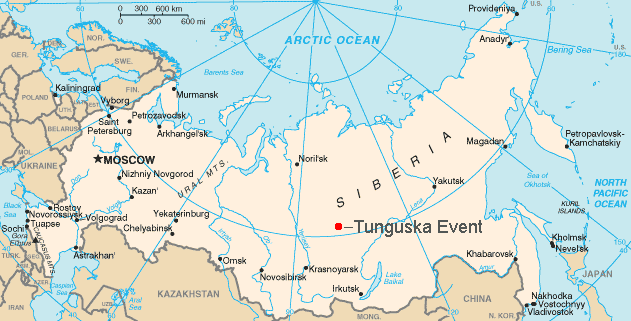
First question is this. Where is Tunguska? Well, it is actually the Podkamennaya Tunguska river. It is a tributary that leads into the Yenisei river, located in the federal subject of the Krasnoyarsk Krai, in central Siberia. The Yenisei river starts in Mongolia, is fed by the Angara, Kan, Podkamennaya Tunguska, and Nizhnyaya Tunguska rivers, and flows into the Arctic Ocean. The largest city along the Yenisei river is Krasnoyarsk.
The first peoples to inhabit this region were the Evenk people. Later on, Russians came from the western part of Russia.
Location of Tunguska in relation to Siberia(top), and the Yenisei river region(bottom)
Now, the event can be discussed. It is widely believed that a meteorite his this spot, causing an explosion on 30 June 1908. It was the largest impact event to ever happen on the earth at that time. It has been thought of that the meteorite might have exploded in the air rather than hitting the ground. Either way, the impact was immense. This blast was 1,000 times more powerful than the atomic bombed that was dropped on Hiroshima,Japan.
The effect of this blast was felt throughout Eurasia. It caused shock waves that registered 5.0 on the Richter scale. The blast also caused changes in the atmospheric pressure that could be found as far away as Great Britain. The forest areas where the blast took place were blown down. One person was killed.
A forest after the Tunguska event. This picture was taken by Leonid Kulik in 1930, 22 years after the explosion.
Now for the Chelyabinsk event. To get an idea of this event, it is important to know where Chelyabinsk is. This is a major city in Siberia, near the Ural Mountains. It is a major center for metallurgy and military machinery.
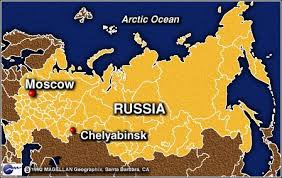
The Chelyabinsk meteorite event is known as the largest impact event since the Tunguska event. It, however, was not as powerful as the Tunguska event. This being said, the impact cannot be measured so much in how explosive it was, but who it affected. In Tunguska, there was one death, and atmospheric changes occurred, as well as seismic changes. In the Chelyabinsk event, this happened in a populated area, where people were living. At least 1,200 people were injured from the blast. There wasn't an actually meteorite that hit the city of Chelyabinsk. However, the effect of it caused damage in Chelyabinsk. Thousands of buildings were damaged and at least 1,200 people were injured. Schools were closed because of the damage. To understand why schools were closed, it is important to assess the climate of Siberia. This is Siberia in February. The average daytime temperature is 17.8 degrees Fahrenheit(-7.9 degrees Centigrade) and at night, the average is -2 degrees Fahrenheit(-18.9 degrees Centigrade). With broken windows, this would be harmful for children in the schools, as temperatures would become almost as cold indoors as outdoors. A zinc factory was damaged. Considering that metallurgy is an important part of Chelyabinsk's economy, this could have an effect on the economy. The damage might cost people for a reason. More time would be needed to rebuild the factory, which takes away time from producing zinc.
One thing to consider with the Chelyabinsk meteor event vis-a-vis Tunguska is its over all effect. Both are events in their own way, but different ways. In the Tunguska event, this caused an affect on atmospheric pressure and was even detected on the Richter scale. In the Chelyabinsk event, this effect a major city. The events of Chelyabinsk can tell alot about how an urban area can be effected by events such as a meteorite vs rural areas being hit by a meteorite.
http://online.wsj.com/article/SB10001424127887324162304578305163574597722.html?mod=WSJ_hpp_LEFTTopStories
http://russian.rt.com/Russia/4400
http://science.nasa.gov/science-news/science-at-nasa/2008/30jun_tunguska/
In the past week, on 15 February 2013, there was a meteorite that hit Russia. It was the largest meteor to hit since the Tunguska meteorite in 1908. It has been long thought of that this could happen again. And in 2013, it did happen again. To truly have an understanding of the impact of the Chelyabinsk meteorite, it is important to look at the Tunguska event.
First question is this. Where is Tunguska? Well, it is actually the Podkamennaya Tunguska river. It is a tributary that leads into the Yenisei river, located in the federal subject of the Krasnoyarsk Krai, in central Siberia. The Yenisei river starts in Mongolia, is fed by the Angara, Kan, Podkamennaya Tunguska, and Nizhnyaya Tunguska rivers, and flows into the Arctic Ocean. The largest city along the Yenisei river is Krasnoyarsk.
The first peoples to inhabit this region were the Evenk people. Later on, Russians came from the western part of Russia.
Location of Tunguska in relation to Siberia(top), and the Yenisei river region(bottom)
Now, the event can be discussed. It is widely believed that a meteorite his this spot, causing an explosion on 30 June 1908. It was the largest impact event to ever happen on the earth at that time. It has been thought of that the meteorite might have exploded in the air rather than hitting the ground. Either way, the impact was immense. This blast was 1,000 times more powerful than the atomic bombed that was dropped on Hiroshima,Japan.
The effect of this blast was felt throughout Eurasia. It caused shock waves that registered 5.0 on the Richter scale. The blast also caused changes in the atmospheric pressure that could be found as far away as Great Britain. The forest areas where the blast took place were blown down. One person was killed.
A forest after the Tunguska event. This picture was taken by Leonid Kulik in 1930, 22 years after the explosion.
Now for the Chelyabinsk event. To get an idea of this event, it is important to know where Chelyabinsk is. This is a major city in Siberia, near the Ural Mountains. It is a major center for metallurgy and military machinery.
The Chelyabinsk meteorite event is known as the largest impact event since the Tunguska event. It, however, was not as powerful as the Tunguska event. This being said, the impact cannot be measured so much in how explosive it was, but who it affected. In Tunguska, there was one death, and atmospheric changes occurred, as well as seismic changes. In the Chelyabinsk event, this happened in a populated area, where people were living. At least 1,200 people were injured from the blast. There wasn't an actually meteorite that hit the city of Chelyabinsk. However, the effect of it caused damage in Chelyabinsk. Thousands of buildings were damaged and at least 1,200 people were injured. Schools were closed because of the damage. To understand why schools were closed, it is important to assess the climate of Siberia. This is Siberia in February. The average daytime temperature is 17.8 degrees Fahrenheit(-7.9 degrees Centigrade) and at night, the average is -2 degrees Fahrenheit(-18.9 degrees Centigrade). With broken windows, this would be harmful for children in the schools, as temperatures would become almost as cold indoors as outdoors. A zinc factory was damaged. Considering that metallurgy is an important part of Chelyabinsk's economy, this could have an effect on the economy. The damage might cost people for a reason. More time would be needed to rebuild the factory, which takes away time from producing zinc.
One thing to consider with the Chelyabinsk meteor event vis-a-vis Tunguska is its over all effect. Both are events in their own way, but different ways. In the Tunguska event, this caused an affect on atmospheric pressure and was even detected on the Richter scale. In the Chelyabinsk event, this effect a major city. The events of Chelyabinsk can tell alot about how an urban area can be effected by events such as a meteorite vs rural areas being hit by a meteorite.
http://online.wsj.com/article/SB10001424127887324162304578305163574597722.html?mod=WSJ_hpp_LEFTTopStories
http://russian.rt.com/Russia/4400
http://science.nasa.gov/science-news/science-at-nasa/2008/30jun_tunguska/
Subscribe to:
Posts (Atom)


.jpg)